
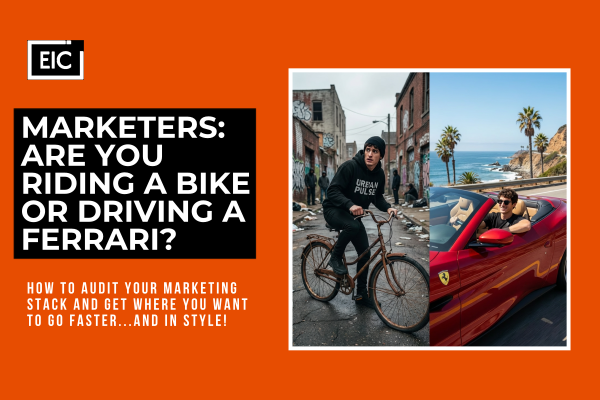
Are You Riding a Bike or Driving a Ferrari? How to Audit Your Marketing Stack
Why Most Businesses Are Moving Too Slow — And Don't Even Know It
Imagine you need to get across town for the most important meeting of your career. You could pedal there on a bicycle — you'd eventually arrive, slightly sweaty, a little late, and definitely not making the impression you were hoping for. Or you could pull up in a Ferrari — on time, composed, and ready to close.
Now apply that same logic to your marketing.
This is the framework that we use when they get on discovery calls with potential clients. And the uncomfortable truth they've uncovered? Most businesses think they're driving a sports car when they're actually on a ten-speed.
So which one are you? Let's break it down.
Book a free 30-minute discovery call
What "Riding a Bike" Looks Like in Your Marketing
The bike isn't an insult — it's a starting point. If you have the following three things in place, you have a functional marketing setup. You're moving. You're just not moving fast, and you're probably not turning heads.
1. Content Creation
Are you producing any content at all? Videos, blog posts, photos, social media posts — anything that communicates your brand and what you sell. If the answer is yes, you have the first wheel on your bike.
2. Content Distribution
Creating content means nothing if no one sees it. Distribution is getting that content in front of people — whether through organic social media, SEO, paid ads, or some combination. You don't need all of them. You just need something working.
3. A Place for People to Land
When someone clicks, where do they go? A website, a landing page, a way to opt in or give you a call. This is the mechanism that turns attention into action. Without it, your distribution efforts are pouring water into sand.
If you have all three of those things running, congratulations — you have a bike. You're moving, and that genuinely puts you ahead of businesses doing nothing. But in a competitive market, a bicycle isn't going to win the race.
What Driving a Ferrari Actually Means
The leap from bike to Ferrari isn't about doing one or two things better. It's about building a system — an interconnected, intelligent marketing machine where every component talks to the others and the whole becomes greater than the sum of its parts.
Here's what that looks like in practice.
Full-Funnel Ad Strategy
A Ferrari-level marketing stack runs ads at every stage of the buyer journey. That means prospecting campaigns that introduce your brand to cold audiences, and retargeting campaigns that re-engage people who have already shown interest. If you're only running one type, you're leaving significant revenue on the table.
The best-performing businesses aren't just running ads — they're running a strategy that mirrors how real people actually make decisions.
Omni-Channel Presence
Your audience is not living on one platform. They're scrolling Instagram in the morning, searching Google at lunch, browsing LinkedIn in the afternoon, and watching TikTok before bed. A Ferrari-level brand meets them in all of those places.
At minimum, you want to be present across Meta, Google, and LinkedIn. Depending on your audience, TikTok and other platforms may be critical as well. Omni-channel isn't about being everywhere for the sake of it — it's about being wherever your buyer is, with the right message, at the right time.
A Fully Built-Out CRM
If the ad strategy is the engine, the CRM is the electrical system — the brain that controls everything and makes sure all the parts are actually working together. A well-built CRM tracks leads from the moment they enter your ecosystem, routes them to the right salesperson, and keeps the conversation moving through the pipeline.
Dustin puts it plainly: "If I turn left and I accidentally go right, that shows the CRM isn't well-intuned and the handoff from lead to sales isn't there."
A Ferrari-level CRM includes lead scoring, automated nurturing sequences, clear handoff processes between marketing and sales, and ROI tracking so you know exactly what's driving revenue. Without this, even the best ad campaign leaks money.
Audience Targeting and Lead Scoring
Not all leads are created equal. A Ferrari-level marketing stack doesn't just collect leads — it qualifies them. Lead scoring assigns value to prospects based on their behavior and attributes, which means your sales team is spending time on the people most likely to convert rather than chasing cold contacts who aren't ready to buy.
Sophisticated audience targeting also means you're building custom audiences, look-alike audiences, and suppression lists so your ad spend is going toward the right people and not being wasted on those who have already converted or will never convert.
Sales and Marketing Alignment
One of the most overlooked components of a high-performing marketing stack is the relationship between the marketing and sales teams. In a Ferrari, they're not operating in silos — they're sharing data, aligning on lead quality, and collaborating on the nurturing process so that no opportunity falls through the cracks.
Marketing brings leads in. Sales closes them. But the space between those two things is where most businesses lose the race.
Book a free 30-minute discovery call
The Component Everyone Ignores: Reporting
If there's one thing that separates a good marketing setup from a great one, it's reporting — and not just surface-level reporting.
Mike calls granular reporting "the gas that goes back into the car." Dustin reframes it as regular maintenance: "The better the oil changes, the better the system, the more tricked out you can make the car."
What does Ferrari-level reporting actually look like?
Creative-level performance data: Which specific ad creative is driving results and which is burning budget?
Channel attribution: Which platforms are producing qualified leads vs. vanity metrics?
Pipeline visibility: Where are leads dropping off between marketing and sales?
ROI tracking: What is your actual cost per acquisition, and how does it compare to customer lifetime value?
Without this level of insight, you're essentially driving blind. You can have a beautiful, powerful car — but if your dashboard isn't working, you don't know how fast you're going, how much fuel you have left, or whether there's a problem under the hood until it's too late.
Reporting transforms marketing from guesswork into a system that can learn, adapt, and scale.
A Simple Self-Assessment: Where Does Your Marketing Stack Fall?
Run through this quick checklist and be honest with yourself.
The Bike Checklist:
[ ] We produce some form of content regularly
[ ] We have at least one channel distributing that content
[ ] We have a website or landing page where leads can take action
The Ferrari Checklist:
[ ] We run both prospecting and retargeting campaigns
[ ] We are present across multiple ad platforms
[ ] We have a CRM that tracks and nurtures leads through the full pipeline
[ ] We have lead scoring in place to prioritize sales conversations
[ ] Our marketing and sales teams are aligned on process and data
[ ] We have granular reporting down to the creative level
If you checked everything in the bike list and nothing in the Ferrari list, you know where to start. If you're somewhere in between — most businesses are — you have a clear picture of what to build next.
Book a free 30-minute discovery call
The Bottom Line: Speed, Style, and Sustainability
Riding a bike isn't a failure. Every business starts somewhere, and having the fundamentals in place is genuinely better than nothing. But if you're running paid ads online and trying to grow, a bike simply isn't built for that race.
The Ferrari isn't about vanity — it's about efficiency, intelligence, and sustainability. It's about building a marketing system that generates leads predictably, converts them consistently, and gives you the data you need to keep improving. It's the difference between hoping your marketing works and knowing it does.
The good news? You don't have to upgrade everything at once. Most businesses make meaningful progress by plugging one or two critical gaps — often the CRM or the reporting layer — and the whole system immediately starts performing better.
The question is knowing which gaps to fill first. That's where the conversation starts.
Ready to Find Out What You're Actually Driving?
If this framework resonated with you — or if you have a nagging feeling that you're missing pieces but aren't sure which ones — this is exactly what Mike and Dustin dig into on discovery calls.
Watch or listen to the full EIC Podcast episode to hear Mike and Dustin walk through the bike-to-Ferrari framework in their own words, including the nuances that don't always make it into a blog post.
Or, if you're ready to get a personalized breakdown of your marketing stack, book a Discovery Call at the EIC website. In 30 minutes, you'll walk away with a clear picture of where you stand, what's missing, and what it would look like to start driving the Ferrari.
Your competitors aren't waiting. Neither should you.
Want to go deeper on this strategy?
Book a free 30-minute discovery call
OR
Watch the full episode of the EIC Podcast
We walk through real client examples, technical setup details, and how this playbook has driven results across industries.
This article is based on insights from the EIC podcast hosted by Mike Patterson and Dustin Trout, digital marketing experts focused on helping businesses maximize their advertising ROI.
