
Google AI Overviews Are Changing Search Forever — Here's What Marketers Need to Know
For roughly twenty years, the Google search results page looked more or less the same. Ten blue links, some ads at the top, maybe a featured snippet if you were lucky. Marketers built entire strategies around that predictable layout, and consumers learned exactly how to navigate it — including how to skip past the ads.
That era is over.
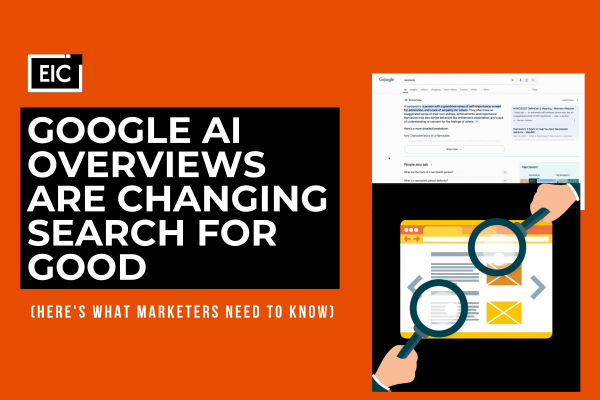
Google's AI Overviews have quietly transformed the search experience into something that looks and feels far more like a conversation with a chatbot than a traditional results page. Instead of a list of links, users are now greeted with an AI-generated summary that attempts to answer their query directly — and the data shows people are embracing it. Search behavior has shifted by roughly 58% in just the last few months, a staggering rate of change for a platform that billions of people have used the same way for decades.
If you run paid advertising, manage a brand's digital presence, or simply care about how customers find you online, this is not a trend you can afford to ignore.
Book a free 30-minute discovery call
Why Google Made This Change (And Why It's Here to Stay)
Let's be clear about something: Google is a business, and search is its largest revenue driver. Any change this sweeping to the core search experience only survives if it makes financial sense. And the numbers say it does.
Google recently beat earnings expectations in a significant way, with search remaining the dominant engine of that growth. That performance directly mirrors the behavioral shift we're seeing — more people are using AI Overviews, engaging longer with the search experience, and apparently transacting more as a result.
There's another dynamic at play here too. Over the past several years, users had become increasingly "ad blind." They learned to spot sponsored listings almost instantly and scroll right past them — even when those ads were genuinely relevant to what they were searching for. The redesigned search experience changes that equation. Sponsored content is now integrated more naturally into the overall presentation, and early data suggests users are engaging with paid listings again at higher rates than before.
In other words, Google didn't just change the look of search — they may have solved one of the biggest challenges in digital advertising: getting people to actually pay attention.
What This Means for Click Volume and Lead Quality
Here's the nuance that every advertiser needs to understand: you will likely see fewer clicks, but better ones.
With AI Overviews doing much of the research legwork directly within the search interface, users no longer need to click through five different websites to gather information. They can ask follow-up questions, refine their research, and get progressively more specific answers — all without leaving Google. By the time someone does click through to your website, they've already done a significant portion of their decision-making process.
That means the clicks you do receive carry much stronger purchase intent. Early anecdotal evidence from campaigns running in this new environment supports this. Brands are seeing a meaningful shift in the quality of inbound leads and online sales conversions, even as raw click volume softens. For businesses that have historically struggled to generate quality leads from paid search, this shift in user behavior could be a genuine breakthrough.
Think of it this way: you'd rather have ten visitors who are ready to buy than a hundred who are just browsing. Google's AI Overviews appear to be quietly engineering that outcome.
How to Get Your Brand Into Google AI Overviews
So how do you actually show up inside these AI-generated summaries? The answer on the paid side comes down to one feature: Google AI Max.
AI Max is a campaign extension that takes your existing search keywords, ad copy, and landing pages and uses them to identify and bid on users whose search behavior aligns with what you're offering. When users engage with AI Overviews, source links appear within the generated content — and AI Max is your mechanism for getting your brand among those links.
It works similarly to Performance Max in its philosophy: you provide the inputs, Google's AI does the optimization. The controls are relatively minimal by design. You can set keyword parameters, define exclusions, and point Google toward your best-performing landing pages, but beyond that, the system is built to learn and self-optimize.
The most important lever you have isn't a campaign setting — it's the quality of the data you feed the system.
Book a free 30-minute discovery call
The Real Secret to AI Max Performance: Your CRM Data
This is where most advertisers will either win or lose in the AI-driven search landscape.
AI Max is only as smart as the data it receives. Out of the gate, the system will generate leads — but not all of them will be quality leads. Google's algorithm needs signals to understand the difference between a casual inquiry and a genuinely sales-qualified lead that converts into closed revenue. Without those signals, it will optimize for volume rather than quality, and your cost per acquisition will suffer.
The solution is offline conversion tracking connected to your CRM.
Here's how it works in practice: your sales team works leads through your CRM pipeline, qualifying them, moving them through stages, and ultimately marking deals as won or lost. That data — which leads became qualified, which ones closed, which ones turned out to be junk — gets pushed back to Google through offline conversion integrations. Over time, this teaches AI Max exactly what a good customer looks like for your business, and it shifts its targeting accordingly.
The result is a compounding improvement in lead quality. The more clean, accurate CRM data you feed back to the platform, the better Google gets at finding more people just like your best customers. It's a flywheel, and the brands that set it up properly now will have a significant advantage over those that don't.
This same principle applies across other major ad platforms as well — Meta, LinkedIn, and others all support offline conversion data, and the logic holds everywhere. But given how central Google Search is to most B2B and B2C buying journeys, getting this right in Google is the highest-leverage place to start.
Real-World Proof: What Happens When You Turn AI Max Off
Theory is useful, but real results are better. Here's a telling example from a recent campaign test.
A client had been running AI Max for a period of time with decent performance. To isolate its impact, the team made the decision to turn it off entirely for two weeks — essentially a controlled experiment to see what life without AI Max looked like.
The results were immediate and stark. Daily conversion volume, both leads and online sales, dropped to near zero within that two-week window. When AI Max was switched back on, conversions began returning within 24 hours. Add-to-carts appeared on day one. Sales followed on day two.
The correlation was impossible to ignore. This isn't a feature that runs in the background with a marginal effect — for this client, it was driving the overwhelming majority of their conversion activity. Turning it off was effectively like turning off their pipeline.
That kind of direct cause-and-effect relationship is rare in digital advertising, where attribution is notoriously messy. When a two-week off/on test produces results that clear, it's worth paying attention.
Book a free 30-minute discovery call
Practical Steps to Win in the AI Overviews Era
If you're ready to adapt your strategy to this new search landscape, here's where to start:
1. Enable Google AI Max immediately. If you're running paid search campaigns and haven't turned this on yet, that's your first priority. The earlier you enable it, the more time the algorithm has to learn and optimize for your specific business.
2. Go broader on your keywords. The traditional paid search playbook favored tight, highly specific keyword lists. In the AI Max environment, broader keyword targeting gives the system more room to find high-intent users you might have been excluding. Test this incrementally, but don't be afraid to expand your reach.
3. Audit and connect your CRM. If your CRM isn't connected to Google via offline conversions, you're flying blind. Set up the integration, define what a quality lead looks like in your pipeline, and make sure that data is flowing back to the platform consistently.
4. Focus on landing page and ad copy quality. AI Max uses your landing pages and ad creative as inputs. The better those assets are, the more effectively the system can match you with the right users. This is a good time to revisit your landing page experience and make sure it clearly communicates your value proposition.
5. Be patient with the learning curve. Like any AI-driven system, AI Max gets better over time. Don't judge it in the first two weeks. Give it time to accumulate data, push your CRM signals back regularly, and let the optimization compound.
The Bottom Line: This Is Search 2.0, and Early Movers Win
Google's AI Overviews represent the most significant evolution in search since the platform launched. The shift isn't cosmetic — it's changing how users research, how they engage with brands, and ultimately how they buy. The advertisers who recognize this shift and adapt their strategies now will enjoy a meaningful competitive advantage before the space gets crowded.
The data is already pointing in the right direction. Higher-quality clicks, re-engaged users who had learned to ignore traditional ads, and direct correlation between AI Max activity and conversion volume — these are all early signals that this new paradigm is working.
Google is not going to slow down here. This is the future of their platform, and they're going to keep building toward it. The question isn't whether your industry will be affected — it's whether you'll be positioned to benefit when it is.
Want to go deeper on how Google AI Overviews and AI Max could fit into your specific paid media strategy?
Book a discovery call today and let's map out exactly how to position your campaigns for the AI-driven search landscape
OR
Watch the full podcast episode
Whether you're just getting started with AI Max or looking to optimize what you already have running, the time to move is now.
This article is based on insights from the EIC podcast hosted by Mike Patterson and Dustin Trout, digital marketing experts focused on helping businesses maximize their advertising ROI.
